
I've been part of Gojek from the time we did a seemingly insignificant thousand orders a day to a few million a month, in about 150 weeks. I didn't have a playbook for that kind of curve, and neither did anyone I could call. Most of what we now run as routine infrastructure was built while the numbers were already climbing past what it was built for.
One in ten Indonesians use our app every month, one in four have it installed.
Monoliths gave way to hundreds of microservices, a query against the database for order counts gave way to real dashboards, and the old mobile app gave way to an actual design language system. None of that happened because we planned it well in advance. It happened because the old version kept breaking under the next order of magnitude, and we rebuilt it under load, which is a slower and messier way to do it than anyone would choose on purpose.
Building for the middle, not the valley
We're not based out of Silicon Valley, and for a while I assumed that was a constraint to work around rather than the reason any of this worked. You build products for the first world by sitting in the first world. But the reverse is also true, and it's the part I underestimated: the biggest gaps to close were here, and closing them meant more per person than the same effort would have meant somewhere already served.
I saw that most clearly with GoFood, our food delivery product I was running as Head of Product at the time (a seat I later talked about at more length on a podcast about design). We found our first GoFood millionaire vendor around the same time our order volume passed every food-tech startup in India combined, and the two facts felt connected rather than coincidental: there just wasn't a market this size, this underserved, anywhere I'd worked before.
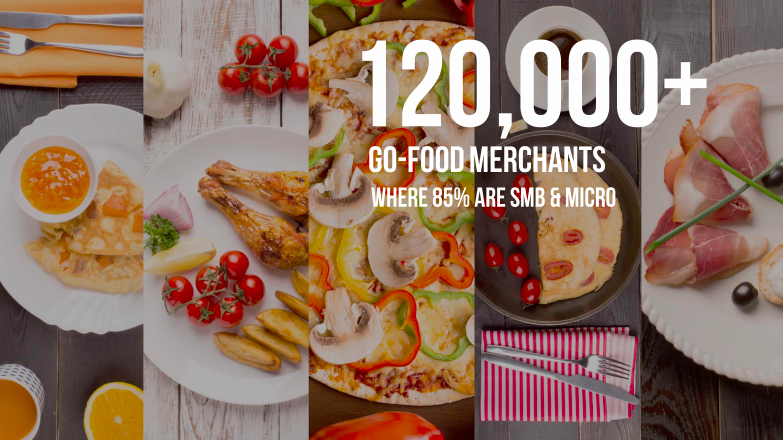
The vendor who stuck with me was a woman selling pisang goreng on the streets of Jakarta. She was making $300 a month before GoFood. Once she started taking delivery orders, she scaled to over $100,000 a month across six stores, employing more than 30 people. I didn't build that outcome, she did, but it wouldn't have been reachable without a platform that could put an unknown street vendor in front of a city's worth of demand overnight.
Arisan Mapan, our microlending product, showed me the same pattern from a different angle: households in villages with no formal credit history using small loans to buy the utensils or send the kids to school that a credit score would have blocked them from elsewhere. Indonesia spans over 17,508 islands with no unified credit rating system, so a straightforward lending product had to be built as much on operations as it was on the tech behind it.
Twenty people doing what took our competitors four hundred
Our transport product team is the core of everything else we run, and we kept it deliberately lean: about 20 engineers where a competitor doing comparable work ran close to 400. That wasn't a badge of honor so much as a forcing function. It meant leaning hard on automation instead of headcount, and it meant we could only afford to hire people who didn't need managing closely, because there weren't enough of us to closely manage anyone. The tradeoff was real: we turned away good candidates who would have done fine work but needed more structure than a 20-person team could give them, and there were stretches where the backlog outpaced what 20 people could reasonably ship.
What made the tradeoff work was a feedback loop I hadn't had at this scale before. Wear a Gojek T-shirt at the airport and someone comes up to talk about the app, unprompted. My helper's son drives for Gojek and tells me about bugs and where the UX doesn't make sense. My real estate agent had opinions about the best way to get picked up outside a mall. One of my drivers sang me a 15-year-old Shah Rukh Khan song and told me he loved India; I told him I couldn't be more grateful for him and for Indonesia. None of that is a research process I set up. It's just what happens when the product is used by a country, not a segment of one.
My helper's son is a Gojek driver. He tells me about bugs and how to improve our UX before any survey does.
That density of feedback, and the scale of what GoFood's vendor was proving was possible, is what eventually made the decision for me: six months before this post, I moved to Indonesia with my wife and two-year-old and called it home. It wasn't a dramatic leap so much as an obvious one once I'd spent enough time seeing what was actually happening here versus what I could see about it from outside.
What the lean years cost, and what they bought
This isn't really a post about how we got this far. It's about what building this way actually asks of you. There were colossal highs and there were real lows, including days I chose not to go home in time to see my two-year-old, which is a cost I don't think you fully square with, you just decide it was worth it in the moment and carry the decision afterward. A 20-person team building for a country this size doesn't get to have many quiet weeks.
What it bought, alongside the vendor stories and the lending numbers, is a company that still runs on the same values it started with even as almost everything else about it has changed. That's the part I didn't expect going in: the tech stack, the org chart, and the product surface have all been rebuilt more than once, but the reason for doing any of it hasn't moved.
I don't know yet what the next phase of this looks like, or how much of the lean-team approach still holds once we're several times this size. That's an open question I'm carrying into whatever comes next, not one I have an answer for here.
Cross posted on the Gojek Engineering Blog